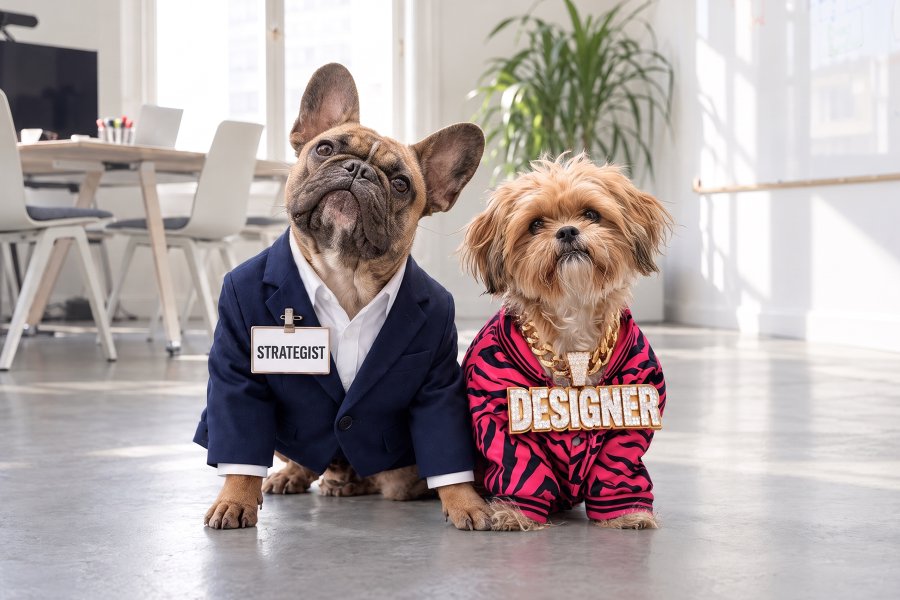
Could designers be the better strategists?
Director of Product and Service Design
A highly relevant and strategically significant topic: Corporate Development (CD) is undergoing a fundamental shift in the age of AI — from being primarily a planning and evaluation function to becoming visionary, technology-enabled, and exploratory. This transformation is particularly evident in fast-moving sectors like mobility and healthcare.
With the rise of AI, the methods of strategic corporate development are evolving dramatically. Instead of long-term planning cycles, an exploratory and iterative approach is gaining ground — characterized by continuous learning and data-driven hypothesis building, all guided by a strong user-centered mindset. AI makes it possible to not only design complex scenarios but to simulate and test them as well — using digital twins of markets, products, or entire value chains.
Strategic decisions are no longer based solely on historical data and linear forecasts. Instead, they rely on real-time pattern recognition, making strategic opportunities and risks visible much earlier.
As a result, strategy work becomes more dynamic, closer to operations, and more technologically grounded. Corporate Development becomes the intersection of behavioral design, business intelligence, AI expertise, and systems thinking — requiring new competencies in data literacy, governance, and interdisciplinary collaboration.
For leadership roles in strategic development, this transformation demands a fundamental shift in mindset — both in individual skillsets and in how the function is embedded within the organization. Future strategists must not only understand market and business dynamics but also possess deep knowledge of data-driven technologies, AI systems, and their regulatory implications on people and organizations. They need to work confidently with uncertainty, formulate hypotheses, and validate them in short cycles alongside tech and product teams. Mastery in areas such as scenario analysis, data-driven business design, and system mapping is becoming essential.
Organizationally, corporate development should be much more tightly integrated with IT, data & analytics, and innovation — through cross-functional task forces, strategic co-creation platforms, or by embedding it in agile product and portfolio management structures. Only those who think strategy, technology, and cultural evolution in unison will not just accompany change, but actively shape it.
The fact that I, as a Design Director, am increasingly being asked to lead strategic development projects is no coincidence — it’s a sign of a paradigm shift.
In a time when organizations must rethink complex systems, embed user-centricity deep into their business models, and shape digital ecosystems, traditional strategy roles often fall short of today’s experiential and technological realities. Experience, service, and innovation designers bring precisely the skills needed: systems thinking, user- and data-centered approaches, fluency in interdisciplinary collaboration, and proficiency in iterative, exploratory methods. Rather than merely analyzing, they actively shape the future — with tangible concepts, prototypes, and validated use cases.
This design-driven mindset, combined with strategic thinking, positions them as ideal drivers of modern, agile, and technology-oriented corporate development.