AI is still in the printing factory
UX Architect
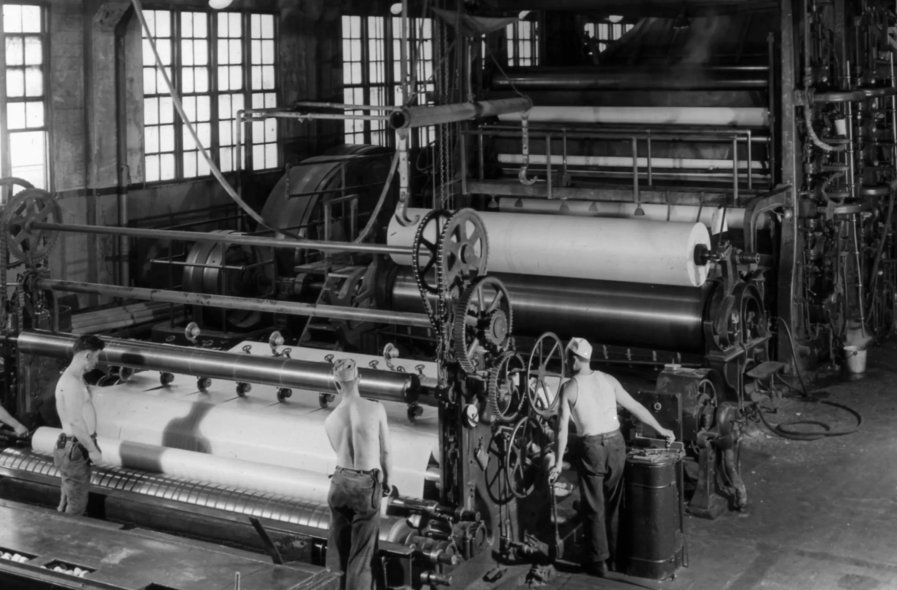
In 1902, a Brooklyn printing factory had a problem: the paper kept warping and ruining the ink. They hired a young engineer named Willis Carrier to fix it. He did, and in doing so, accidentally invented air conditioning. :) Nobody celebrated it. Nobody imagined what it would become.
We are at step one with AI. And step one, as history reminds us, always looks a little ridiculous in hindsight.
The first air conditioner was not built for comfort. It was built with one unglamorous goal: keep the room dry in humid summer weather so the paper wouldn’t warp and smear the ink. Cooling the air was an accidental side effect. Twenty years later, the same technology was installed in a handful of theatres, because cinemas were losing audiences every summer. Nobody wanted to sit in a hot room packed with strangers. Air conditioning fixed that problem, and in fixing it, accidentally invented something else entirely: the summer blockbuster. Jaws. Star Wars. Grease. Billions of dollars of culture, born from a machine originally designed to stop paper from warping.
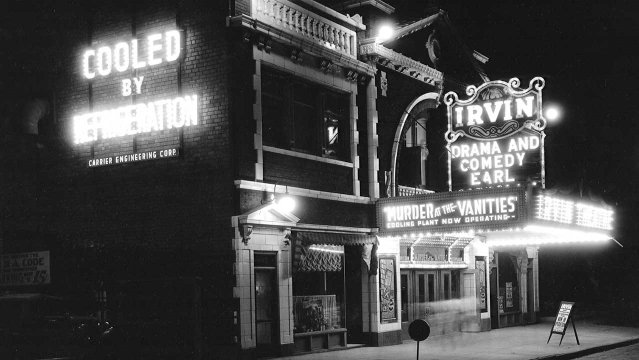
Air-Conditioned Irvin Theatre in Bloomington (Image credit: McLean County Museum of History)
Then it miniaturised. It left the theatre, entered the home, and quietly changed everything. Not just the temperature of our rooms, but the architecture of our buildings, the geography of our cities, the populations of entire regions, and yes, the outcomes of elections. Controlled air turned the American Sun Belt from an uncomfortable swamp into the most politically decisive region in the country. Nobody who installed that first unit in Brooklyn could have predicted any of that.
This is what happens when a technology becomes part of everyday life. It doesn’t just solve the problem it was built for. It creates an entirely new world as a side effect.
The steam engine was built to pump water out of flooded mines. Electricity was sold as a novelty lighting system for the wealthy. The internet was designed for academics to share research papers. Each of them ended up inside everything. We call them General Purpose Technologies. The pattern is always the same. The surprise is always the same.
AI is the next one. Almost certainly.
But right now, AI is still in the printing factory. Every time you ask an AI to help you write an email, book a meeting, or summarise a document, your request leaves your device, travels across the internet, gets processed inside one of the most energy-intensive structures humans have ever built, and travels back to you. A data centre the size of several city blocks, consuming the electricity of a small town, cooled by millions of litres of water, all mobilised so you can send an email to your manager.
The proof of concept is extraordinary. The execution is, to put it gently, not yet elegant. Historically speaking, this is a recognisable moment. We have been here before.
Every technology that has ever mattered has followed the same three steps. First, the proof of concept: huge, expensive, built for institutions rather than people. Then miniaturisation: cheaper, smaller, creeping toward the individual. Then everywhere: invisible, so woven into daily life that we stop noticing it entirely. And at that third stage, something unexpected always happens. The technology stops being a product and starts being infrastructure. Quietly, it becomes part of the fabric of everyday life.
The miniaturisation itself follows its own logic, and we have a precise record of how it happens.
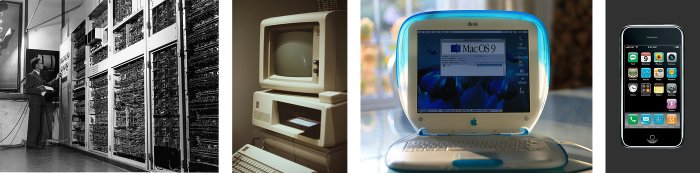
The first transistor in 1947 was hand-assembled in a Bell Labs laboratory and measured about a centimetre long, part of a computer that filled an entire room. Eleven years later, the integrated circuit placed multiple transistors onto a single chip. Twenty years after that, the microprocessor put an entire computer onto that chip. The room became a desk. The desk became a laptop.
The laptop became a device in your pocket more powerful than anything that existed in that lab in 1947. This was not planned. It followed the pattern. AI is already following it too, quietly, without much fanfare.
Apple today runs an AI model, measured in billions of connections, entirely on your iPhone without sending a single byte to a data centre. Samsung built a model so small it fits comfortably on a phone, yet outperforms systems thousands of times its size on certain reasoning tasks, simply by thinking more efficiently. The brute force era is already giving way to the efficiency era. The factory doors are beginning to open.
The question worth asking now is not whether AI will miniaturise. It will. The question is what happens when it does. Because when a technology stops living in a centralised institution and moves into your home, your pocket, your life, something fundamental changes. It stops being a service you access and becomes a tool you own. It stops being something that knows about you because you logged in, and becomes something that knows you because it lives with you. Yours, in the way your thoughts are yours.
That shift has happened before. Every time it has, the world changed in ways that made the previous version look, in retrospect, like a printing factory wondering why its paper kept warping.
We are still in the factory. But the theatre is already being built.
In the coming weeks, we will explore a “What if…” scenario where AI becomes part of everyday life. A thought experiment. If AI follows the pattern, if it miniaturises, becomes more personal, and becomes as invisible as the air in your room, what happens to the way we work, build, create and connect?